
On Oct. 22, 2025, the U.S. Department of the Treasury's Office of Foreign Assets Control sanctioned Rosneft Oil Co. and Lukoil OAO, two of Russia's largest oil companies. The designations were made pursuant to Executive Order No. 14024 authorizing blocking property of persons operating in specified sectors of the Russian Federation economy — including the energy sector.
As a result, all property and interests in property of Rosneft and Lukoil in the U.S., or in the possession or control of U.S. persons, are blocked, and U.S. persons are prohibited from engaging in transactions with them unless authorized. Subsidiaries in which Lukoil, Rosneft or other blocked persons hold an interest of 50% or greater are automatically blocked under OFAC's 50% rule.
Export control restrictions also apply. Under a presumption of denial, items subject to the Export Administration Regulations may not be exported or reexported to these entities without a license.
Furthermore, the sanctions designations carry the possibility of secondary sanctions on non-U.S. persons that engage in significant transactions with these entities or provide them with material support.
OFAC's action followed similar measures enacted by the U.K. in October that targeted Lukoil and Rosneft with comparable restrictions. The U.S. sanctions were also coordinated with enactment of the EU's 19th round of sanctions against Russia since 2022, which include a ban on Russian liquefied natural gas imports and further limit transactions involving Rosneft.
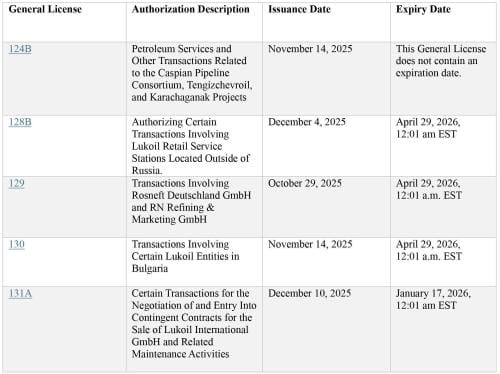
OFAC has issued temporary general licenses to allow U.S. and foreign companies to engage in certain business with the restricted entities.
Regarding Lukoil in particular, this includes a general license authorizing maintenance of operations and business of entities owned by Lukoil's international holding company, Lukoil International GmbH, and the negotiation — but not execution — of contracts for the sale or disposition of such entities until Jan. 17. The actual sale or disposition of such assets must be separately authorized by OFAC through a specific license.
The chart below provides an overview of the relevant general licenses that are currently in effect, including their issuance and expiration dates.
Impact on Russia's Economy and Energy Sector
The significance of targeting Rosneft and Lukoil cannot be overstated. Together, they account for roughly half of Russia's oil production and a major portion of Russia's seaborne export flows. These sanctions therefore strike at one of Russia's principal sources of revenue.
Notably, Russia's energy sector was already under considerable stress prior to the imposition of the sanctions, its oil and gas revenues having dropped by 21% over the first 10 months of 2025 compared to the same period in 2024.
For third-country importers of Russian crude — such as India, China and certain EU states — there is significant risk. Continuing to import significant volumes from Rosneft or Lukoil poses at least reputational and financial risk, and may invite secondary sanctions.
In October, it was reported that in response a number of Chinese and Indian oil importers had already suspended or reduced imports of Russian oil.
Impact on U.S. and Foreign Businesses
Any U.S. companies with remaining exposure to Rosneft, Lukoil or their subsidiaries should seek to wind down such activity, and otherwise only engage in business that is authorized under an OFAC general license.
Businesses outside the U.S. that operate in the energy sector should carefully review their operations for any links to Lukoil or Rosneft. Even when it appears unlikely that U.S. sanctions apply, many foreign companies inadvertently fall under U.S. jurisdiction because a part of their activities involve American persons or pass through the U.S. — for example, when financial transactions are processed by U.S. banks.
Oil producers and service providers, in particular, should consider their contractual obligations as activities with Lukoil and Rosneft are put on hold.
Additionally, non-U.S. financial institutions now face potential sanctions for maintaining relationships with Lukoil or Rosneft, whether as customers, recipients or business partners. Furthermore, it should be noted that activities outside the U.S. that are entirely beyond the reach of U.S. sanctions jurisdiction can still be subject to U.S. secondary sanctions to the extent they involve Rosneft, Lukoil or their subsidiaries.
Notably, Section 744.8 of the Export Administration Regulations imposes comprehensive export controls over any entity designated by OFAC in connection with Russia's actions in Ukraine. Consequently, a license is now mandatory for the export, reexport or in-country transfer to Rosneft or Lukoil of any item subject to the export regulations.
This includes goods, software or technology that is (1) in the U.S.; (2) of U.S. origin, wherever located; (3) of non-U.S. origin, incorporating more than a de minimis level of controlled U.S. content; and (4) of non-U.S. origin, and is the direct product of certain technology or software subject to U.S. export control jurisdiction.
It should also be noted that under the recently adopted — and then suspended — affiliates rule, which restricts exports to foreign companies that are 50% or more owned by entities on the Bureau of Industry and Security's Entity list or Military End User list, or on OFAC's Specially Designated Nationals and Blocked Persons list, these same extensive restrictions would apply to all foreign affiliates in which Rosneft or Lukoil hold a majority ownership interest.
Although on Nov. 10, 2025, the U.S. Department of Commerce suspended the affiliates rule through Nov. 9, 2026, exporters should prepare for compliance when the suspension lapses or in the event that Commerce reimposes the rule before then.
"US Sanctions Targeting Russia’s Oil Giants Heighten Biz Risks," by Anthony Rapa and Ekinsu Cebi Elkei was published in Law360 on January 6, 2026.