

While the U.S. Supreme Court continues to deliberate the legality of certain tariffs imposed by President Trump under the International Emergency Economic Powers Act (“IEEPA”), those who paid the challenged “reciprocal” and “trafficking” tariffs are anticipating the potential for tariff refunds in the event that the Court finds the tariffs were imposed without lawful authority.
There is significant uncertainty as to what a refund process might look like and what importers that have paid the tariffs will need to do to get refunds if the Supreme Court invalidates the IEEPA tariffs. However, based on recent developments, it now seems unnecessary (and futile) for importers to file a lawsuit in the U.S. Court of International Trade (“CIT”) to seek an injunction against liquidation of IEEPA duties already paid.
Background
Since returning to office in January 2025, President Trump has frequently relied on IEEPA to support his “America First” trade policy. As of today, tariffs imposed under IEEPA include:
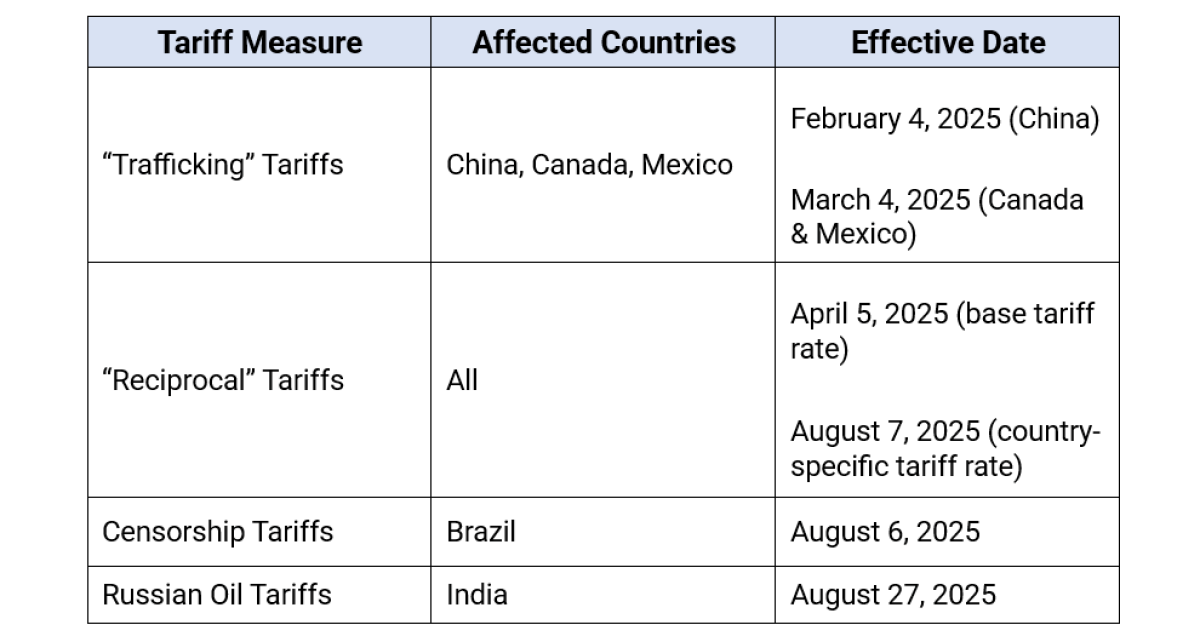
In April, a handful of U.S. importers and a dozen state attorneys general filed two separate lawsuits, challenging the President’s authority to impose broad and sweeping tariffs (in particular, the “reciprocal” and “trafficking” tariffs) under authority of IEEPA. On May 28, the CIT found that the IEEPA tariffs exceeded the President’s statutory authority under IEEPA and permanently enjoined their operation as to all imports. The Trump Administration quickly appealed the matter, and the U.S. Court of Appeals for the Federal Circuit (“CAFC”) temporarily stayed the lower court’s order until it had an opportunity to decide the issue. The CAFC upheld the CIT’s decision on August 29, 2025, but remanded the lower court’s universal injunction. Shortly thereafter, the Trump Administration petitioned the Supreme Court for review and asked the Court to consider that matter on an expedited basis.
The Supreme Court heard oral argument on November 3 and is expected to issue its opinion in early 2026. At oral argument, several Justices, as well as the parties, expressed uncertainty as to whether and how already-collected duties would be refunded if the IEEPA tariffs were found to have been unlawful. Although it is unclear how the Court will rule, Administration officials have signaled that they may pursue alternative tariffing methods should the Supreme Court strike down the IEEPA tariffs. It is not known whether such alternative arrangements would only apply going forward, or whether the Administration will attempt to make any new measures retroactive.
In the meantime, U.S. Customs and Border Protection (“CBP” or “Customs”) has begun taking steps to liquidate (i.e., finalize and transfer to the U.S. Treasury) some of the duties collected under IEEPA authority. After CBP denied requests for extensions of liquidation, several importers filed suit at the CIT to assert their own challenges to the IEEPA tariffs and to seek injunctions preventing liquidation pending the Supreme Court’s decision on the legality of the tariffs. The same three-judge panel of the CIT that had previously ruled that the tariffs were unlawful has now denied the first set of requests for injunctions against liquidation. The CIT concluded that there would be an opportunity for refunds even after liquidation if the Supreme Court were to rule that the IEEPA tariffs are invalid. Although this may provide some temporary assurances that there is no need for importers to seek immediate injunctions against liquidation, it should be noted that the CIT’s decisions are subject to potential appeal and the process by which importers may ultimately seek to obtain refunds remains uncertain.
Key Questions Answered
Because the future of IEEPA tariffs remains uncertain, many importers share similar questions about the process for securing a tariff refund. We answer those critical questions below.
1) Many of the products I imported into the United States were subject to IEEPA tariffs. Do I need to do anything to secure a refund?
The short answer is that nothing needs to be done immediately, but it is likely that some action will need to be taken in the future.
Once an item is “entered” into U.S. Customs territory, CBP generally takes 314 days to compute or ascertain the total amount of duties owed on an entry (a process referred to as “liquidation”). If an importer wishes to contest the liquidation of an entry, the importer (or other authorized person) normally must file a protest with Customs no later than 180 days after the goods were liquidated. If the protest is denied, the importer can then file suit in the CIT challenging the denial. As explained further below, however, this traditional protest mechanism is likely not available to challenge CBP collection of the IEEPA tariffs. So, some other action by importers wanting to recover their paid IEEPA tariffs will probably be necessary.
As identified in the chart below, entries subject to IEEPA “trafficking” tariffs may have already begun liquidating. Until December 15, it was unclear whether an importer’s refund strategy might depend on the liquidation status of its entries. In particular, there was concern that, unless an importer challenged the IEEPA tariffs in court and secured an injunction against liquidation, the CIT might not have the authority to order reliquidation if the Supreme Court were to find the tariffs unlawful.
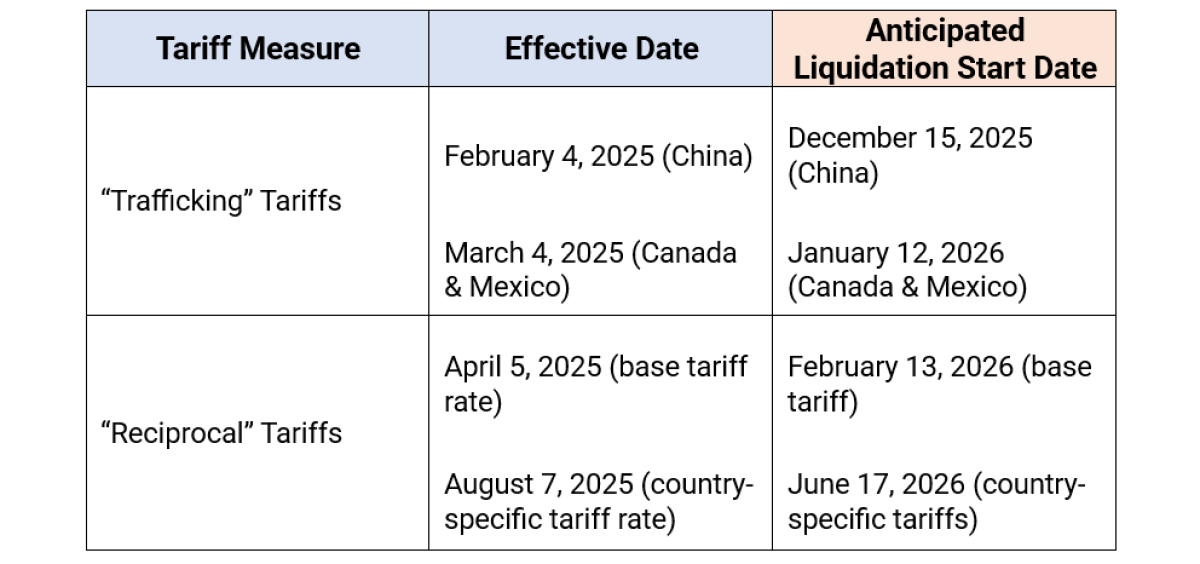
A December 15 decision from the CIT has put that issue to rest, at least for now. On that date, a three-judge panel at the CIT (the same panel that initially found the tariffs to be unconstitutional in May) rejected a request that the court enjoin liquidation of the plaintiffs’ entries. Plaintiffs had argued that, because it was uncertain whether the CIT would have the power to order reliquidation of entries, they were entitled to an order preventing the liquidation of their entries pending a ruling by the Supreme Court. The court decided otherwise, concluding that the CIT has “the explicit power to order reliquidation and refunds where the government has unlawfully exacted duties.” The court also found it important that the government had repeatedly assured the court that it would not oppose reliquidation of entries. As the CIT emphasized, because the Administration
convinced [the CIT] to accept that importers who paid IEEPA tariffs will be able to receive refunds after reliquidation, and having benefitted from the court’s subsequent conclusion that importers will not experience irreparable harm as a consequence of liquidation, the Government cannot later ‘assume a contrary position’ to argue that refunds are not available after liquidation.
The court’s decision also rejected the availability of one of the remedies that some practitioners had argued would be the proper way to secure refunds—the traditional route of filing a protest with CBP. In that regard, the court noted that CBP’s collection of the IEEPA tariffs is a mere administrative action as to which CBP has no discretion. As a consequence, the CIT stated, CBP’s collection of the IEEPA duties would not be protestable decision.
2) Do I need to take action to secure tariff refund, and when must I do it?
Importers that paid IEEPA tariffs would likely benefit from being proactive in ensuring that their records are in good order and reflect the details on each entry for which refunds may be available if the tariffs are found to be unlawful.
In light of the CIT’s December 15 decision, the urgency of filing action at the CIT has abated. However, there are at least two reasons why an importer may nevertheless decide to file suit.
First, the mechanism by which the thousands of affected importers will be able to recover duties is not yet known. It may be the case that filing a lawsuit will be required, or CBP may establish an administrative mechanism for processing refund claims. If a lawsuit is required, filing sooner rather than later may give an importer a better place in line to secure refunds at an earlier date.
Second, whatever system is eventually developed to allow importers to request and secure refunds, CBP may not be able to process all refunds at the same time. Some group of importers will have to be first up, and those that do file suit have as good a chance as any to be among that group. Thus, for example, if CBP does establish an administrative mechanism, it might give priority to importers that have sued to get refunds in the CIT.
Aside from the option of commencing an action at the CIT, importers may also wish to request extensions of liquidation from CBP and, if liquidations occur, consider the possibility of filing protests (which generally are due within 180 days after liquidation). Although the CIT’s December 15 decision indicated that the protest mechanism is unavailable to challenge the IEEPA tariffs, that decision could at some point be challenged and reversed. Whether these options, or others, are advisable will depend on numerous circumstances particular to each importer and on developments likely to occur in the coming weeks.
Takeaways and Additional Considerations
- If the Supreme Court finds that IEEPA-based tariffs are unlawful, it is possible that CBP could institute an automated refund process—although it is unclear how such a process would work.
- Alternatively, the Supreme Court could rule against the tariffs and still conclude that CBP need not issue tariff refunds to importers other than those involved in the specific lawsuit in which the ruling is made. Should this occur, importers may wish to file a refund lawsuit with the CIT.
- Even if the Supreme Court invalidates IEEPA tariffs, broad tariffs could still remain as members of the Trump Administration have hinted at the use of alternative legal authority to impose measures similar to those currently being reviewed by the Court.
- Import compliance is a top enforcement priority of the second Trump Administration. Importers must continue to monitor global developments and properly maintain import records.
For further analysis, or to discuss how the tariff refund process may affect your business or operations, please contact Eric S. Parnes, Alan G. Kashdan, Timothy J. Hruby, Rachel D. Evans, or another member of Blank Rome’s International Trade group.