

The Federal Energy Regulatory Commission (“FERC” or the “Commission”) issued an order on December 18, 2025, creating a framework for how large co-located loads, such as data centers, can connect to the grid in a timely, efficient, and fair manner.[1] In February 2025, the Commission initiated Docket No. EL25-49-000, a show cause proceeding under section 206 of the Federal Power Act (“FPA”), directing PJM Interconnection, L.L.C. (“PJM”) and PJM transmission owners to show cause as to why PJM’s governing documents addressing service arrangements between and among generators and co-located load remain just and reasonable and not unduly discriminatory or preferential.
The Commission’s Order—finding that PJM’s current tariff is unjust and unreasonable—directs PJM to implement revisions to clarify what steps entities must take to effectuate co-located load arrangements, to establish three new transmission services, and to create new behind-the-meter generation rules. The Order also seeks additional briefing on the appropriate rates, terms, and conditions of the new transmission service offerings.
First, several key terms are important to understand in the context of the Commission’s Order. The Order defines “Co-Located Load” to mean a “configuration that refers to end-use customer load that is physically connected to the facilities of an existing or planned Customer Facility on the Interconnection Customer’s side of the Point of Interconnection to the PJM Transmission System.”[2] A “Co-Location Arrangement” refers to both the Co-Located Load and the associated generator. Other capitalized terms used throughout the Order are defined in PJM’s tariff.[3]
FERC v. States: Who Has Jurisdiction?
Regulating large loads, such as data centers, requires involvement from local, state, and federal entities. FERC’s jurisdiction is limited; it can only regulate matters that Congress authorizes. Under the FPA, states have authority over any matters not expressly conveyed to the Commission.[4] The Order addresses the jurisdictional divide in the specific context of Co-Located Load, noting that FERC has authority to oversee the terms and conditions of generator interconnection to any Commission-jurisdictional distribution facility or transmission facility, and to ensure that rates for transmission service in interstate commerce are just and reasonable.[5] Concurrently, states retain exclusive jurisdiction over the specific terms of retail sales, generator siting, the generation mix, and transmission in intrastate commerce.[6]
Why PJM’s Tariff Is Not Just and Reasonable
The Commission ultimately found that PJM’s current tariff is not just and reasonable, and the Order focused on three key reasons for this: (1) a lack of consistency and clarity regarding serving Co-Located Load, (2) failure to properly allocate costs to the entities that cause the costs to be incurred and reap the resulting benefits, and (3) outdated behind-the-meter generation (“BTMG”) rules that do not account for large loads on the scale of data centers.
- Consistency and Clarity
Large Co-Located Load on the scale of data centers is a relatively new concept, and energy regulators must find ways to ensure that such load can quickly connect to the grid and receive service, while balancing the needs for system reliability and resource adequacy. FERC found that PJM’s existing tariff does not contemplate the various procedures necessary to ensure that such large loads are able to connect to the PJM system in an efficient, reliable, and fair manner. Without clear guidance, transmission owners have taken different approaches to serve Co-Located Load, resulting in disparate treatment and confusion. The Order found that PJM’s tariff has no clear mechanism to address situations in which a Co-Located Load withdraws energy from the transmission system.[7] Additionally, PJM’s tariff does not address any nuance associated with the variety of Co-Location Arrangements that may seek service. For example, PJM’s tariff does not include transmission services that could accommodate the fact that some Co-Located Loads are purportedly able and willing to limit their energy withdrawals from the grid under certain circumstances.[8]
- Cost-Causation and Allocation
FERC’s long-standing cost-causation principle requires costs to be allocated to those who cause costs to be incurred and who reap the resulting benefits. Cost allocation is not an exact science, but Commission precedent dictates that costs should be roughly commensurate with benefits. Except in the scenario in which a Co-Located Load is completely segregated and takes no services from the grid, as a general matter Co-Located Load is synchronized with the grid and benefits at least in some way from ancillary services. The Commission’s Order found that PJM’s tariff fails to address charges related to Co-Located Loads’ use of these services, focusing in particular on regulation services[9] and black start services.[10]
- Behind-the-Meter Generation
The Commission analyzed PJM’s tariff provisions regarding BTMG and found the existing rules to be unjust and unreasonable. PJM’s current BTMG rules were put into place with substantially smaller loads in mind, such as a warehouse building with solar panels. The current BTMG rules allow Network Customers to net an unlimited amount of qualifying load by using BTMG. The Commission found this unworkable in the context of large Co-Located Load.[11] The Order explained that allowing large loads to net creates reliability and resource adequacy issues, and PJM’s current tariff does not provide adequate protection against resultant costs shifting onto other customers.
How FERC Wants PJM to Fix It
The Commission issued PJM a number of directives to bring its tariff up to a just and reasonable standard.
- Addressing Cost Assignment: Specifying the Eligible Customer
The Order directs PJM to revise its generation interconnection procedures, pro forma Generation Interconnection Agreement (“GIA”),[12] and Common Service Provisions to require that Interconnection Customers specify an “Eligible Customer” who will take transmission service on behalf of the Co-Located Load and be responsible for executing the transmission service agreement.[13] The Eligible Customer, defined by PJM’s tariff,[14] could be any person generating electric energy for resale or any retail customer taking unbundled transmission service under certain conditions, such as electric utilities and power marketers. Eligible Customers may take transmission service on behalf of Co-Located Loads in different ways. The Order provides the following example: “[S]ubject to the applicable state law, the Eligible Customer could create a corporate intermediary to serve the Co-Located Load, or the Co-Located Load, acting as an Eligible Customer, could request service from the relevant transmission owner directly.”[15] The purpose of specifying an Eligible Customer is to ensure that charges for transmission and ancillary services are appropriately assigned.
- New Transmission Services: NITS and Contract Demand Services
The Commission found that PJM’s existing Network Integration Transmission Service (“NITS”) continues to be a just and reasonable option when charged on a gross demand basis, but it is not a one-size-fits-all option suitable for all types of Co-Located Load. As a result, PJM must offer three new types of transmission service: (a) an interim, non-firm transmission service for Eligible Customers seeking to take NITS; (b) a firm contract demand transmission service; and (c) a non-firm contract demand transmission service.
NITS and Interim Non-Firm Service. The interim, non-firm transmission service is designed to address concerns with a Co-Located Load’s ability to quickly interconnect to PJM and begin operations. It allows Eligible Customers who intend to take service under NITS, but must undergo Network Upgrades, to take non-firm interruptible service until the Network Upgrades are complete and the Co-Located Load can be designated as Network Load. NITS customers benefit from the right to be served from PJM’s system at any time, and from the fact that NITS load is incorporated into PJM’s transmission planning.[16]
Contract Demand Services. The new firm and non-firm contract demand services are intended to recognize that some Co-Location Arrangements include systems that have the ability to control or limit energy withdrawals from the grid, such as during peak system stress periods. Co-Located Load taking contract demand services would not become Network Load and would be separately metered from the associated generator. Eligible Customers can take a combination of firm and non-firm contract demand transmission services. Under the firm contract demand service, an Eligible Customer can request transmission service up to a specified megawatt (“MW”) quantity for a minimum term of one year. Under the non-firm contract demand service, an Eligible Customer may reserve service during normal operations for terms ranging from one hour to one month. Both contract demand services will be subject to some form of penalty for any excess energy withdrawals above the contracted quantities.[17] PJM must include an anti-toggling mechanism in the terms and conditions for contract demand service to prevent customers from switching between firm and non-firm services based on expected capacity market conditions.[18] The table below summarizes some of the key features of each service option.
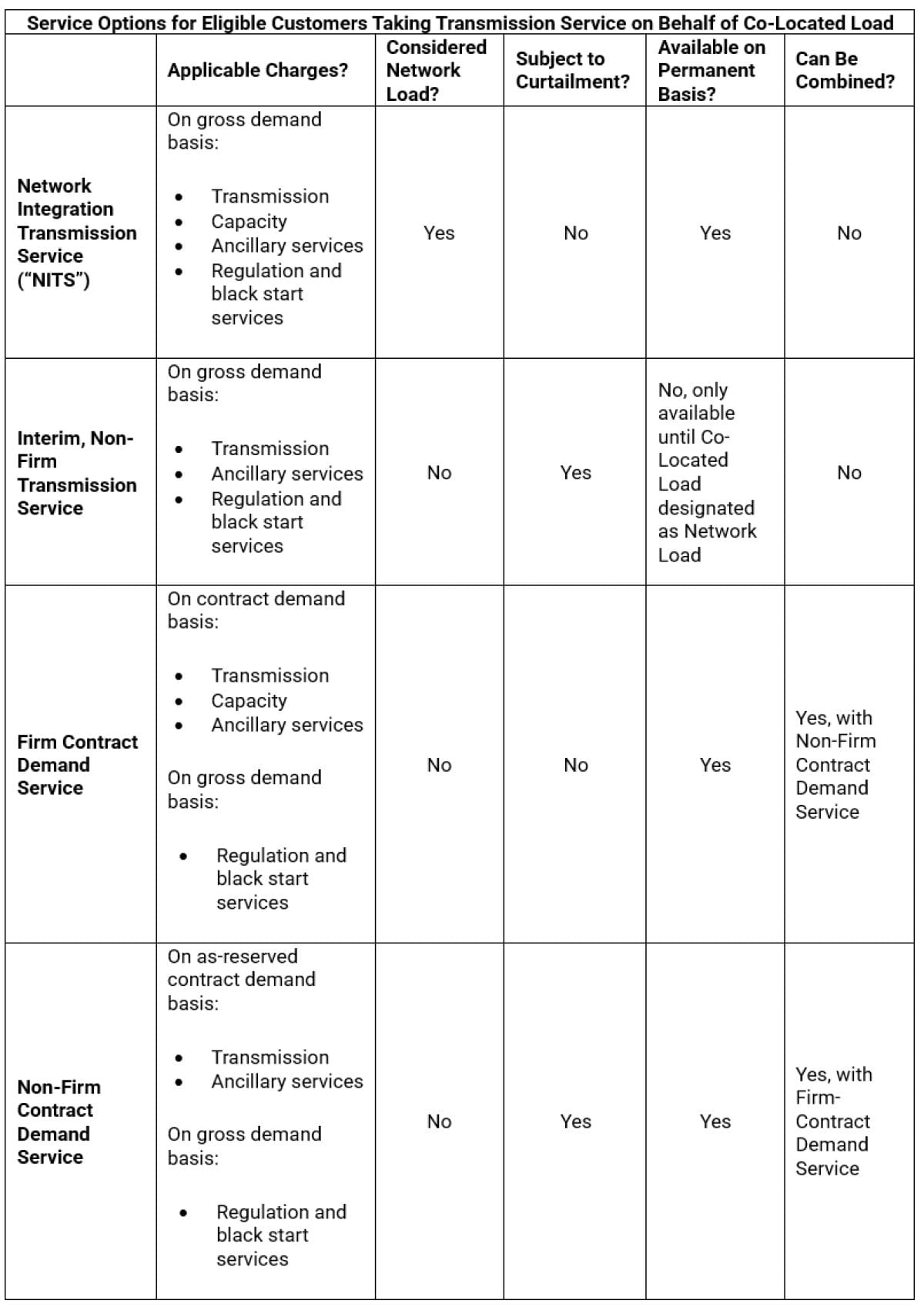
To resolve remaining questions surrounding the just and reasonable rates, terms, and conditions of these new transmission services, the Commission established paper hearing procedures.[19] The paper hearing procedures will address questions such as whether the rate charged to Eligible Customers taking contract demand transmission services should include an additional minimum charge beyond the charges for regulation and black start services, and how to formulate penalties for contract demand customers who withdraw excess energy.
- Behind-the-Meter Generation: New Rules and Impacts to Existing BTMG Customers
The Order does not make any changes to PJM’s existing non-retail BTMG rules but directs substantial changes for retail customers with Network Load. PJM must propose a new MW threshold for the amount of load at a particular electrical location that Network Customers may net using BTMG.[20] As points of reference, the Order notes that the Commission defines a small generator as 20 MW, and PJM currently requires any generator larger than 10 MW to be individually metered.[21] The new threshold will be determined at a later date.
For existing BTMG customers, certain entities will be grandfathered into the current BTMG rules, while others will undergo a transition to the new BTMG rules. The grandfathering rule will apply to entities who have contracted for the specific purpose of effectuating a BTMG arrangement, and the current BTMG rules will apply to the current term remaining under any such existing contract.[22] All other current Network Customer using BTMG will be allowed a three-year transition period, expiring on December 18, 2028.[23]
- Existing Interconnection Customers Serving Co-Located Load: Necessary Study Process
The Commission directed PJM to revise its tariff to clarify that any existing Interconnection Customers who seek to modify a current ISA or GIA to allow their generating facilities to serve Co-Located Load must follow the necessary study process to effectuate such an arrangement.[24] The revisions must specify that the Interconnection Customer will be responsible for all costs of any necessary modifications or Network Upgrades. Service to a Co-Located Load can only commence once all required Network Upgrades, special protection schemes, and metering are in place.
- New Generating Facilities: Accelerating Connection
For new generating facilities who wish to serve Co-Located Load, the Order directs PJM to clarify certain tariff provisions to ensure the process is efficient.[25] PJM must consider requests for interconnection service below the nameplate capacity of a facility or for provisional service. Interconnection Customers may request Surplus Interconnection Service or use existing acceleration procedures for new service requests where there is no cost allocation for Network Upgrades and no further studies are needed. Additionally, the Commission encouraged PJM to adopt further tariff provisions that accelerate interconnection studies for new generation associated with new Co-Located Load to timely match new load with needed generation and to avoid resource adequacy problems.[26]
- Informational Report: Stakeholder Proposals
Lastly, the Order requires PJM to submit a detailed informational report to apprise the Commission of the status of several proposals considered in PJM’s Critical Issue Fast Path (“CIFP”) stakeholder process, which was initiated by PJM’s Board of Managers in August 2025 to address matters related to large load additions, system reliability, and resource adequacy.[27]
What Comes Next?
The Order established deadlines for PJM to file tariff revisions addressing the directives set forth by the Commission and created a briefing schedule to seek additional record evidence regarding the appropriate replacement rates, terms, and conditions for PJM’s new transmission service offerings.
- January 20, 2026: PJM must file (1) tariff revisions to address new generating facilities serving Co-Located Load and (2) an informational report on CIFP stakeholder proposals.
- February 16, 2026: PJM must file its initial brief and tariff revisions addressing: (1) generation interconnection procedures, pro forma GIA, and Common Service Provisions; (2) necessary study process for existing Interconnection Customers; (3) the three new transmission service offerings; and (4) new BTMG rules.
- March 18, 2026: Responses to PJM’s initial brief are due.
- April 17, 2026: Replies to responsive briefs are due.
- December 18, 2028: The transition period for current Network Customers using BTMG ends.
Blank Rome will continue to monitor and report on federal regulatory changes impacting large co-locating loads.
For more information or assistance, please contact Mark R. Haskell, Brett A. Snyder, Lamiya N. Rahman, Emily S. Childress, or another member of Blank Rome’s Energy group.
[1]PJM Interconnection, L.L.C., 193 FERC ¶ 61,217 (2025) [hereinafter PJM Order].
[2]Id. at P 1 n.3. The Commission directed PJM to incorporate this definition into its tariff. Id. at P 164.
[3]See PJM Governing Documents, Open Access Transmission Tariff, available at agreements.pjm.com/oatt/3898.
[4]Nat’l Ass’n of Regul. Util. Comm’rs v. FERC, 964 F.3d 1177, 1187 (D.C. Cir. 2020) (citing N. Nat. Gas Co. v. State Corp. Comm’n of the State of Kan., 372 U.S. 84, 91-93 (1963)).
[5] PJM Order at PP 171-174.
[6]Id. at PP 167-170.
[7]Id. at P 176.
[8]Id. at P 177.
[9] Regulation services are those necessary to provide for continuous balancing of resources with load and for maintaining the grid’s standard 60 Hz frequency. Id. at P 184.
[10] Black start services refer to the ability of generators to start without an outside electric supply or to remain operational when disconnected from the transmission system. Id. at P 185.
[11]Id. at PP 179, 186.
[12] PJM renamed its pro forma Interconnection Service Agreement (“ISA”) to the pro forma GIA when PJM transitioned its interconnection process from a serial first-come, first-served process to a first-ready, first-served cluster study approach. See PJM Interconnection, L.L.C., 181 FERC ¶ 61,162 (2022).
[13] PJM Order at PP 188-191.
[14] PJM, Intra-PJM Tariffs, OATT, § I.1 Definitions – E-F (41.0.0).
[15] PJM Order at P 189 n.407.
[16]Id. at P 198.
[17]Id. at PP 212, 217.
[18]Id. at P 213.
[19]Id. at P 219.
[20]Id. at P 221.
[21]Id.
[22]Id. at P 224.
[23]Id. at P 223.
[24]Id. at PP 225-230.
[25]Id. at PP 232-235.
[26]Id. at P 236.
[27]Id. at PP 237-239.