

Executive Summary
The Committee on Foreign Investment in the United States (“CFIUS” or the “Committee”) released its Annual Report to Congress for Calendar Year 2025 (the “2025 Report” the “Annual Report”) on August 7, 2026. An analysis of the 2025 Report, when gauged historically, and with a more focused comparison to the 2022, 2023, and 2024 Annual Reports, reveals that filing volumes, mitigation agreements, and non-notified inquiries track historical trends, even as CFIUS implements both new initiatives (notably the Known Investor Program (“KIP”)) and seeks to implement more fully President Trump’s America First Investment Policy (“AFIP”).
As with prior years, the Annual Report may be more notable for what it does not disclose than for what it does disclose. While the Annual Report provides select statistics relating to the transactions filed and reviewed, both in declaration and notice form, it makes no effort to correlate the data in the ways that would be most useful to transacting parties seeking to make reasoned judgments on whether to submit a transaction to CFIUS or not. Thus, the Annual Report provides interesting information on the foreign home countries of entities submitting transactions to CFIUS, and simultaneously tells how many transactions were submitted under a wide array of North American Industry Classification System (“NAICS”) codes. But it does not seek to tie those things together. For example, the Annual Report tells us that China submitted the most notices, but not what kind of transactions those notices reported, thus leaving out critical context that would help the reader to better understand the bigger picture of Chinese investment in the United States.
From the data that is available, transacting parties can find information on trends relating to when parties are submitting their transactions for review (by country and industry involved), and generalized information concerning the likelihood that declarations lead to notices and reviews lead to investigations.
Readers of the Annual Report should keep in mind its purpose. It is less to provide the public with information and more to inform Congress, which gets a much more in-depth classified report that answers many of the questions left in the public report. The public version reflects the leftovers of the seven-course Congressional meal.
With this in mind, here is what is available from the Annual Report:
- Total filings increased seven percent from 2024 to 2025 to 347 (207 notices and 140 declarations), reversing a two-year decline and tracking a broader rebound in global mergers & acquisitions (“M&A”) activity.
- The number of distinct transactions reviewed by the Committee held essentially flat, reflecting an uptick in withdrawals and re-filings.
- Declarations increased notably from 2024 to 2025, but the clearance rate for declarations fell to approximately 66 percent from 78 percent in 2024.
- The rate at which CFIUS required a notice following a declaration rose to a three-year high of approximately 26 percent.
- CFIUS announced no civil monetary penalties in 2025 after imposing penalties five times in 2024, but took other actions to signal enforcement remains a focus:
- The Committee issued two formal noncompliance determinations for missed mandatory filings.
- CFIUS took a foreign party to court when it failed to timely divest in accordance with a Presidential Order.
- Japan, the United Arab Emirates (“UAE”), and Canada submitted the most overall filings. China submitted the most joint voluntary notices (“JVNs”). This trend is consistent with prior years that suggest parties from allied countries will seek to use the declaration process much more than those from adversarial nations.
We address each of these trends in this report.
Filing Volume Trends, CY2022–CY2025
Calendar year (“CY”) 2025 saw a modest rebound in the number of transactions considered by CFIUS, following a post-2022 reset. These numbers tend to track with the global M&A market surge in 2021 and 2022, post-COVID. The Committee reviewed 347 total filings in 2025—207 notices and 140 declarations—a seven percent increase over the 325 filings reported for 2024, and marginally above the 342 filings reported for 2023.
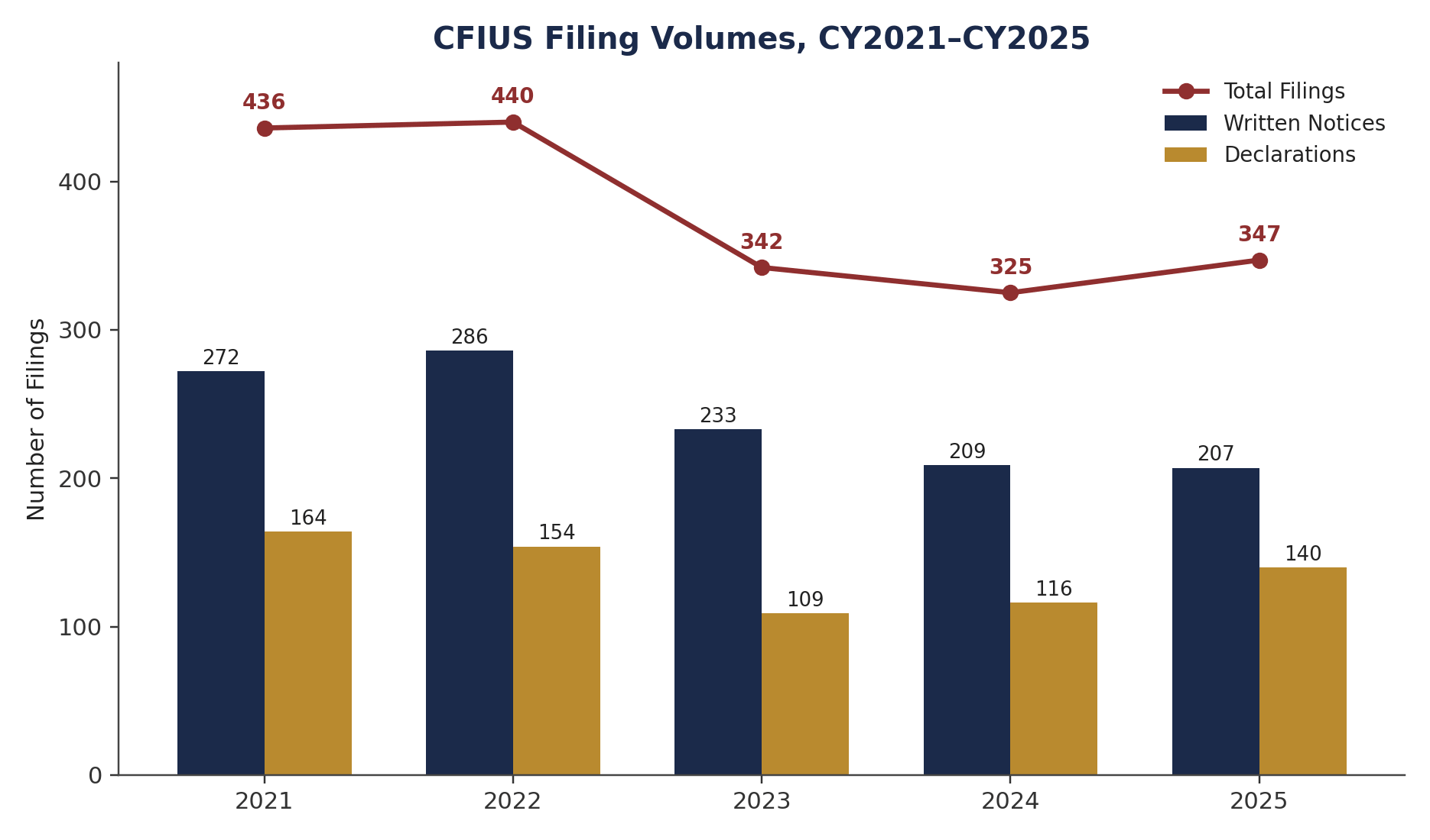
The chart above reflects “raw filing” statistics. However, the raw filing count overstates the number of distinct transactions the Committee actually reviewed, because it double-counts (a) notices that were withdrawn and refiled in the same calendar year, and (b) declarations that were converted into full notices in the same year. Adjusting for both effects, CFIUS reviewed approximately 274 distinct transactions in 2025 and 277 in 2024, notwithstanding the increase in raw filings. The use of declarations rose 21 percent year-over-year to 140 (the highest level since 2022), while notices continued their slow four-year decline to 207.
CFIUS Filing Volumes
| Filing type | 2021 | 2022 | 2023 | 2024 | 2025 |
|---|---|---|---|---|---|
| Written Notices | 272 | 286 | 233 | 209 | 207 |
| Declarations | 164 | 154 | 109 | 116 | 140 |
| Total Filings | 436 | 440 | 342 | 325 | 347 |
| Est. Distinct Transactions | 354 | 337 | 287 | 277 | 274 |
“Distinct transactions” derived by subtracting same-year withdraw-and-refiles and declarations converted to notices from total filings.
These statistics do not suggest that CFIUS is somehow handling more cases or that there is a one-for-one with the broader M&A market. CFIUS filings remained relatively flat on distinct transactions while global M&A value reached an estimated $4.8 trillion in 2025, up 36 to 41 percent over 2024 and the second-highest total on record.
One happier tidbit comes from CFIUS working hard to shorten the time it takes to get a notice on file. CFIUS provided comments on draft notices in an average of approximately 5.35 business days, and the Committee averaged 3.44 business days to formally accept a notice, both broadly consistent with recent years. Whether this trend holds is unclear, however, since the 43-day lapse in appropriations that shut down the federal government in late 2025 likely allowed CFIUS to “tee up” a number of items. (CFIUS formally tolled statutory case deadlines during the shutdown, and the Annual Report’s timing statistics are calculated net of tolled days.)
Declaration Usage vs. Notices
The 2025 Report includes relevant details regarding trends in the use of the declaration submission—CFIUS’s short-form, 30-day assessment process. Parties used the declaration process 140 times in 2025. Approximately 36 percent (51) were mandatory filings and seven percent (7) were real estate filings under 31 C.F.R. part 802. The Committee cleared 92 declaration transactions at the end of the 30-day period (approximately 66 percent), requested that parties file a notice in 36 instances (approximately 26 percent), and declined to take action in 11 instances (approximately eight percent). No declarations were rejected, and one was withdrawn. The declination can be frustrating for parties unless they then voluntarily follow up with a notice.
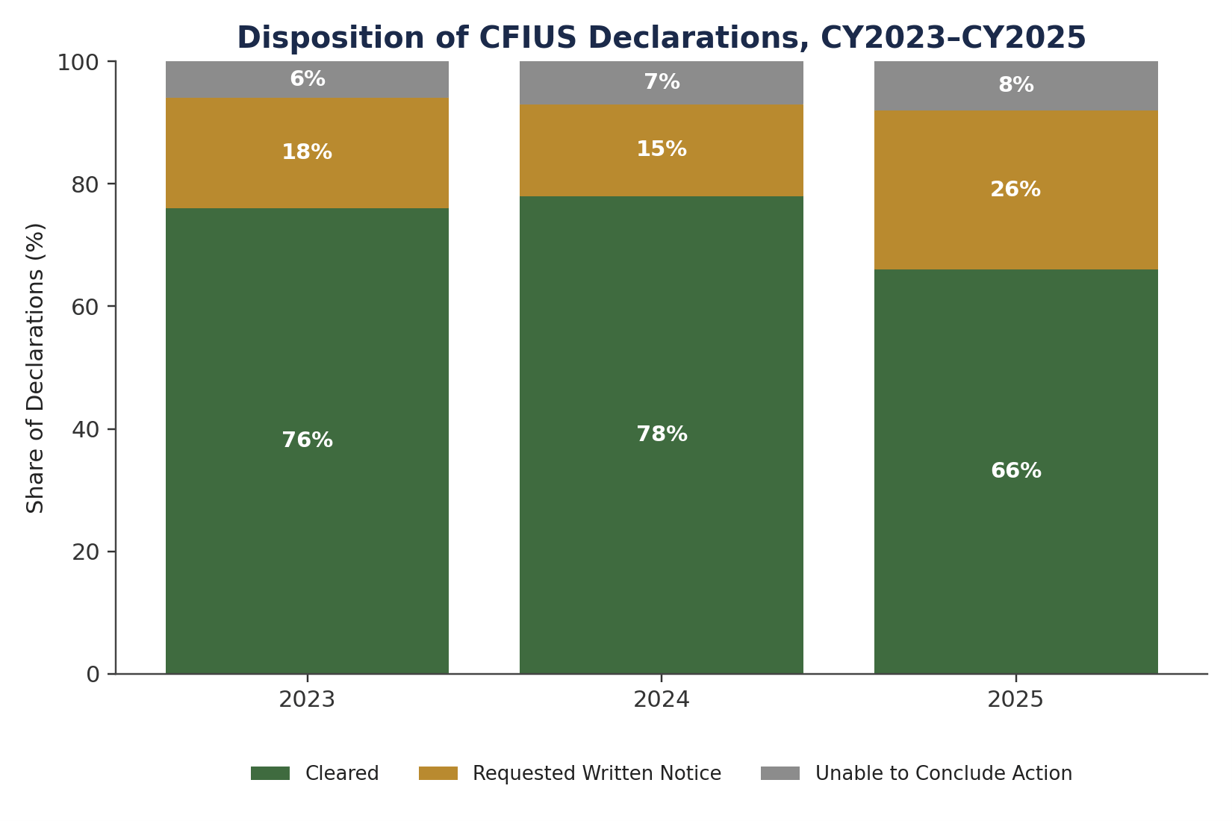
The clearance rate of approximately 66 percent in 2025 is a decline from 78 percent in 2024 and 76 percent in 2023, while the rate of requests for a notice—approximately 26 percent—is the highest recorded in the last three reporting years (compared to approximately 15 percent in 2024 and 18 percent in 2023). However, in context, the clearance rate looks less dramatically different. Because of the much larger number of declarations submitted (140 in 2025, 116 in 2024, and 109 in 2023), the actual number of declarations cleared shows much less difference: 2025 saw 92 declarations cleared, while 2024 and 2023 saw 90 and 83, respectively.
As noted in the introduction, this data could suggest, as some have argued, that CFIUS more aggressively required notices; or it could indicate that the declaration submissions themselves became more aggressive in terms of seeking a quick result for a more complex transaction. Perhaps buoyed by the higher percentages in 2023 and 2024, parties decided to “test the waters” more aggressively in 2025.
Parties can pay a price for miscalculation, however. When CFIUS requires a notice filing after a declaration clearance is declined, the parties not only lose the benefit of the abbreviated 30-day process; it restarts the clock with a 45-day review period (following a likely additional one to three weeks to collect the additional information needed for the notice filing, and opens the process to a subsequent 45-day investigation. This adds markedly to the timeline than if the parties had filed the JVN in the first instance.
The Committee’s notice statistics tell a complementary story. Of the 207 notices reviewed in 2025, 114 (approximately 55 percent) proceeded from the initial 45-day review period into an additional 45-day investigation. This was in line with the historical average—from 2016–2025, approximately 56 percent of the 2,263 notices filed resulted in investigations. In 2025, 25 notices (approximately 12 percent) concluded with mitigation measures or conditions, CFIUS approved 61 withdrawals (approximately 29 percent; keeping in mind some cases got withdrawn more than once), seven (approximately three percent) were abandoned after CFIUS was unable to identify adequate mitigation or the parties declined proposed mitigation terms, three were rejected, and two transactions were ultimately the subject of a presidential prohibition.
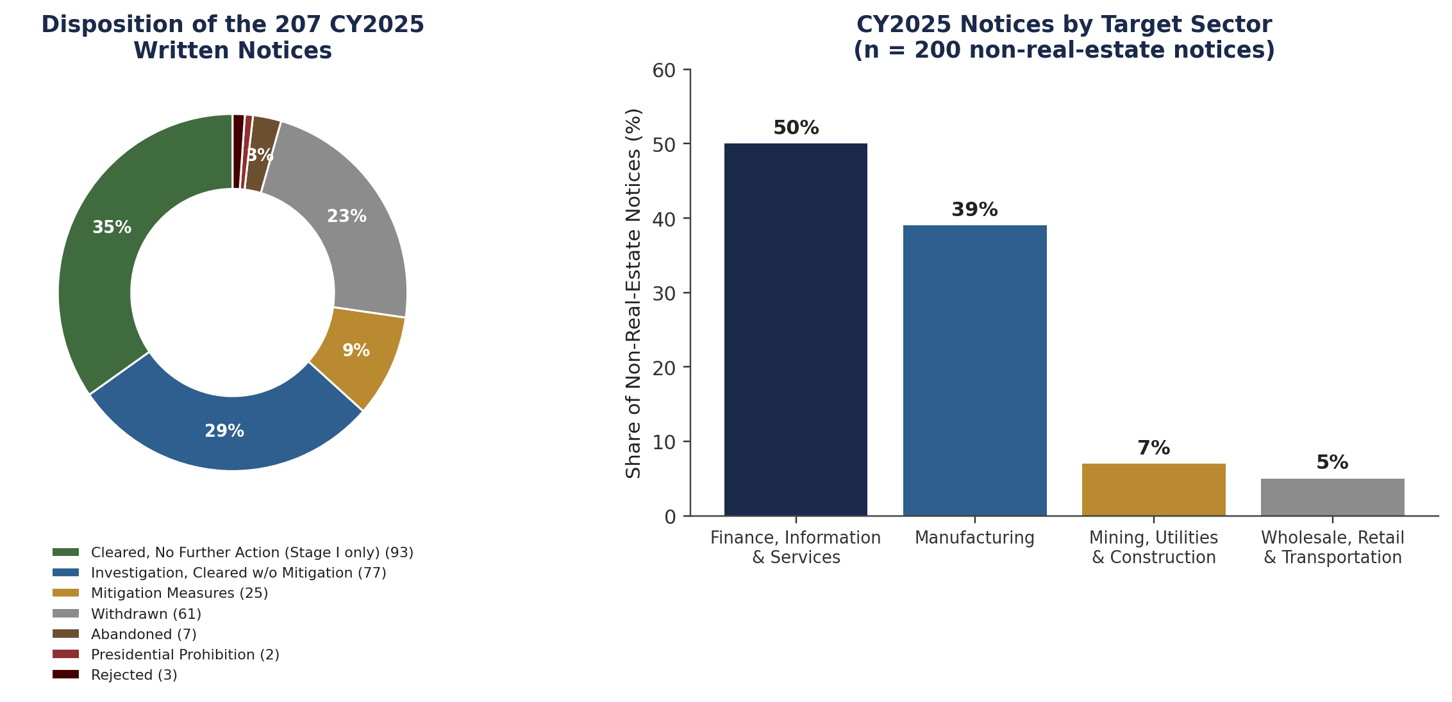
The 29 percent withdrawal rate for notices in 2025 is numerically higher than 2024 (about 23 percent), but as noted above, includes cases withdrawn more than once. Additionally, the government shutdown, which tolled deadlines, likely led to several additional withdrawals.
Mitigation, Monitoring, and Enforcement
A major goal of the AFIP is to rethink how CFIUS implements mitigation. The AFIP directs CFIUS to “cease the use of overly bureaucratic, complex, and open-ended ‘mitigation’ agreements for United States investments from foreign adversary countries” and to favor mitigation “consist[ing] of concrete actions that companies can complete within a specific time.” Based on the 2025 Report, it does not appear that CFIUS has fully implemented these goals, though it is also doubtful that the Annual Reports will ever provide strong insight into their implementation. The number of new mitigation agreements CFIUS entered into in 2025 held steady with 2024’s number, each of which was well below the number of new agreements imposed in 2023. And the number of terminated agreements kept pace with 2024. Thus, the overall number of agreements being monitored as of year-end 2025 reflects only a small reduction (234 versus 242). The same number of new agreements were imposed in 2025 as 2024 (17 each year). While general information about types of mitigation used is provided, no information about how that mitigation is deployed is revealed. Thus, the Annual Report provides no insight into when different types of mitigation are employed, what industries or national security issues require those measures, or which countries, if any, result in certain types of mitigation. Simply put, the public version of the Annual Report is not a barometer for this information.
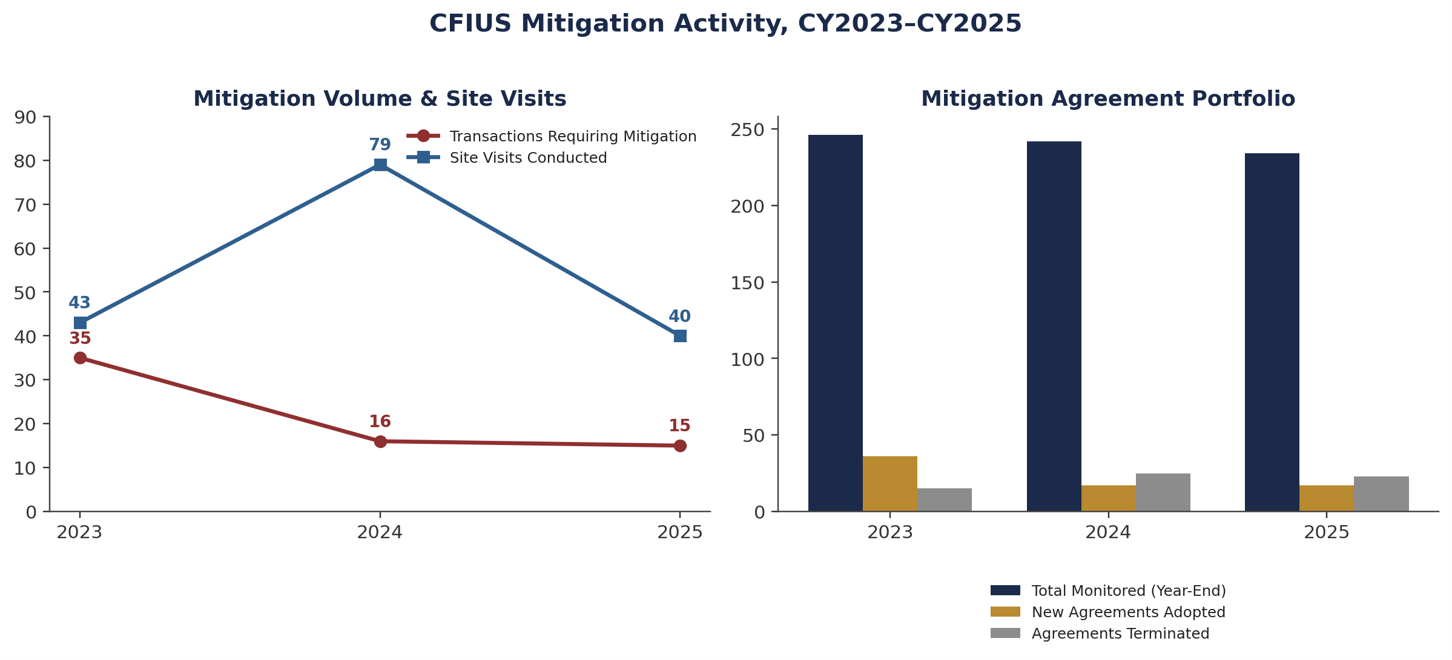
In 2025, site-visit activity by CFIUS Monitoring Agencies (“CMAs”) fell to 40, about half the 79 reported in 2024, though closer to the 43 conducted in 2023. CMAs have used site visits as a way to actively monitor mitigation agreement compliance. A major area of contention exists when a CFIUS National Security Agreement (“NSA”) requires the parties to retain, in perpetuity, expensive monitoring systems and consultants, often at a cost of several million dollars annually. Many transactions cannot support such costs, resulting in abandonment of the deal. For those that enter into NSA’s, the CMAs use site visits to get a hands-on feel for compliance with the NSA’s terms. The 2025 Report notes that CMAs identified instances of non-compliance during a number of these visits, yet no monetary penalties resulted, differing from 2024, when CFIUS assessed five civil monetary penalties totaling more than $86 million. Four of the fines were for breaches of material provisions of mitigation agreements. Given reports of staffing challenges, 2026 may see further declines in site visits.
An important missing metric here, however, is how many of the mitigation agreements (NSAs) mandate third-party monitors and/or auditors and how much private parties are spending on them. Transaction parties are thus left with little to use to assess the reasonableness of a proposed NSA or predict the costs of such compliance.
While 2025 seemingly provided an enforcement holiday, the 2025 Report seeks to dissuade complacency, confirming that the Committee continued to “receive and act on” voluntary self-disclosures regarding potential failures to file mandatory declarations and other violations. Rather than impose fines in 2025, CFIUS issued two determinations of noncompliance with respect to mandatory filing requirements. These are a form of no action letters, or warnings. It is likely that new enforcement cases are working their way through the pipeline (self-disclosure review, negotiation, and potential settlement can span multiple reporting years). However, there is a definite reduced appetite to assess eye-popping fines as a way to propel compliance.
While no fines were assessed, 2025 saw a notable action on the enforcement front when CFIUS sought judicial aid to enforce compliance with a presidential divestiture order. When Suirui International Co., Limited and its affiliates failed to meet the deadline set by President Trump’s order requiring it to divest Jupiter Systems, LLC, the U.S. government sought injunctive relief in federal court. The D.C. District Court granted the government’s request and appointed a receiver to take control of Jupiter Systems’ assets; an appeal remains pending.
The Jupiter Systems case is hardly a surprise. In the face of a clear rope-a-dope tactic, CFIUS determined that the parties were not moving in good faith to comply with the order, and took action. Perhaps more surprising is the decision not to also pursue a civil enforcement action.
The extremely public and political saga of Nippon Steel’s acquisition of U.S. Steel also came to an end in 2025, and is therefore included in this Annual Report. Ultimately, President Trump overturned then-President Biden’s ’s attempt to block the transaction, which was widely seen as a product of election year politics. In a June 2026 order, President Trump approved the transaction subject to a novel mitigation package that included a “golden share” arrangement. Combined with the recent TikTok resolution (which itself dragged on for almost a decade), these actions show that finality in CFIUS decisions is important if a safe harbor is to be received. It is doubtful, for example, that a transaction that has been cleared could be subject to later presidential action without raising numerous legal and constitutional issues. But, a blocked deal is certainly susceptible to changing political climates, if the parties have the fortitude to continue their pursuit of the deal.
Non-Notified Transaction Activity
CFIUS has specific statutory authority to look into transactions that are not brought before it by the parties. This process is referred to as “non-notified” transaction review, and consists of an initial CFIUS outreach to gather factual transaction information (and possibly multiple requests), followed by an internal CFIUS assessment. If CFIUS concludes that a review is warranted (i.e., the transaction raises or could raise national security issues) then it requests that the parties submit a notice. That request comes with the warning that if no notice is submitted, CFIUS can and likely will self-initiate an investigation into the transaction. It is an offer the parties generally cannot refuse.
The non-notified process emphasizes the fact that a transaction is not free from CFIUS risk unless and until a clearance is obtained. Thus, parties who elect to forgo a voluntary filing on the theory that a transaction falls outside CFIUS jurisdiction or presents only attenuated national security risk can find themselves, well after the transaction closes, in a “discussion” with CFIUS over mitigation, or worse, subject to a divestment order. More than a few presidential divestiture orders arose from non-notified transactions.
The non-notified process is all internal and represents a triage approach based on national security concerns identified by one or more CFIUS agencies. The 2025 Report states that the Committee considered “thousands” of potentially covered non-notified transactions, further investigated 90 of them, and opened 62 formal inquiries. Ultimately CFIUS requested a filing in only nine cases. Two additional transactions were submitted for CFIUS review after a non-notified outreach (but before a formal request issued) and are thus counted in the non-notified discussion. The 2025 non-notified activity also reflects a sharpening of the CFIUS pencil. While every year a large number of transactions are considered throughout the non-notified process, the number of filings requested has dropped from 2022 to 2025, both in raw numbers and as a percentage of the outreaches made.
| Non-Notified Process Results | 2022 | 2023 | 2024 | 2025 |
|---|---|---|---|---|
| Transactions Further Investigated | Not included | Not included | 98 | 90 |
| Formal Inquiries Opened | 84 | 60 | 76 | 62 |
| Filings Formally Requested | 11 (~13%) | 13 (~22%) | 12 (~16%) | 9 (~15%) |
| Voluntary Filings After Outreach | Not included | 3 | 5 | 2 |
Little can be gleaned from this small number of cases, and little information is provided about whether they are concentrated in any specific areas (i.e., supply chain concerns, an industry or technology, or involving an adversary nation). The key point the non-notified process continues to demonstrate is that CFIUS retains authority to review non-notified transactions long after closing. The July 2025 presidential order requiring divestment of Jupiter Systems concerned a transaction that closed in 2020. CFIUS’ position is that there is no statute of limitations on its non-notified review authority. That proposition has yet to be tested in court. Unless and until a court disagrees, the only mechanism by which parties can obtain the safe harbor from future CFIUS review is by submitting the transaction for CFIUS review. While waiting may be a viable strategy, it should be done after consideration of the risks.
Sector and Country-of-Origin Information
The 2025 Report’s sector data confirms the continuing trend that parties in certain sectors are more likely to seek the CFIUS safe harbor (evident across the last four years). It is important to recognize that the types of matters before CFIUS are determined in two ways: (1) A mandatory filing is required; or (2) the parties submit a voluntary filing. The 2025 Report does not include data on the number of mandatory filings made, but indicates that a large number of cases involved “critical technology” (166 of the 200 non-real-estate notices reviewed in 2025, or about 83 percent, involved a U.S. critical technology business). Given that critical technology is a class often requiring a mandatory submission, it is likely a substantial number of filings that involved such technology were mandatory. However, the uncertainty in these numbers makes any real extrapolation difficult.
Thus, a substantial number of cases before CFIUS are there because the parties voluntarily sought review. As a result, the industry and country data have less utility, because they reflect hundreds of independent decisions as to whether a filing was required or whether the risk calculus led to a voluntary filing. They do not reflect any trend on CFIUS’ part.
With that in mind, the 2025 Report shows that the Finance, Information, and Services (“FIS”) sector (by NAICS code) remains the largest single category of filers, accounting for approximately 50 percent (99 of 200) of non-real-estate notices in 2025, versus 53 percent in 2024. “Manufacturing” (which includes numerous NAICS codes) accounted for approximately 39 percent of 2025 notices (up from 33 percent in 2024), and the remainder were spread across a wide array of industries.
Country-of-origin data for 2025 illustrates a pattern that may be more reflective of specific case tumult than any real trend. Japanese based parties submitted the most 2025 filings (measured by total filings (notices plus declarations)), followed by China, Germany, and a three-way tie among Canada, France, and the UAE, with Singapore close behind. When adjusted for distinct transactions—removing refiled notices and declarations that were converted to notices—the leading filer countries were Japan, the UAE, and Canada. Thus, China-based entities submitted far fewer independent transactions than the other countries. When considering the types of filings, the distinction becomes more understandable.
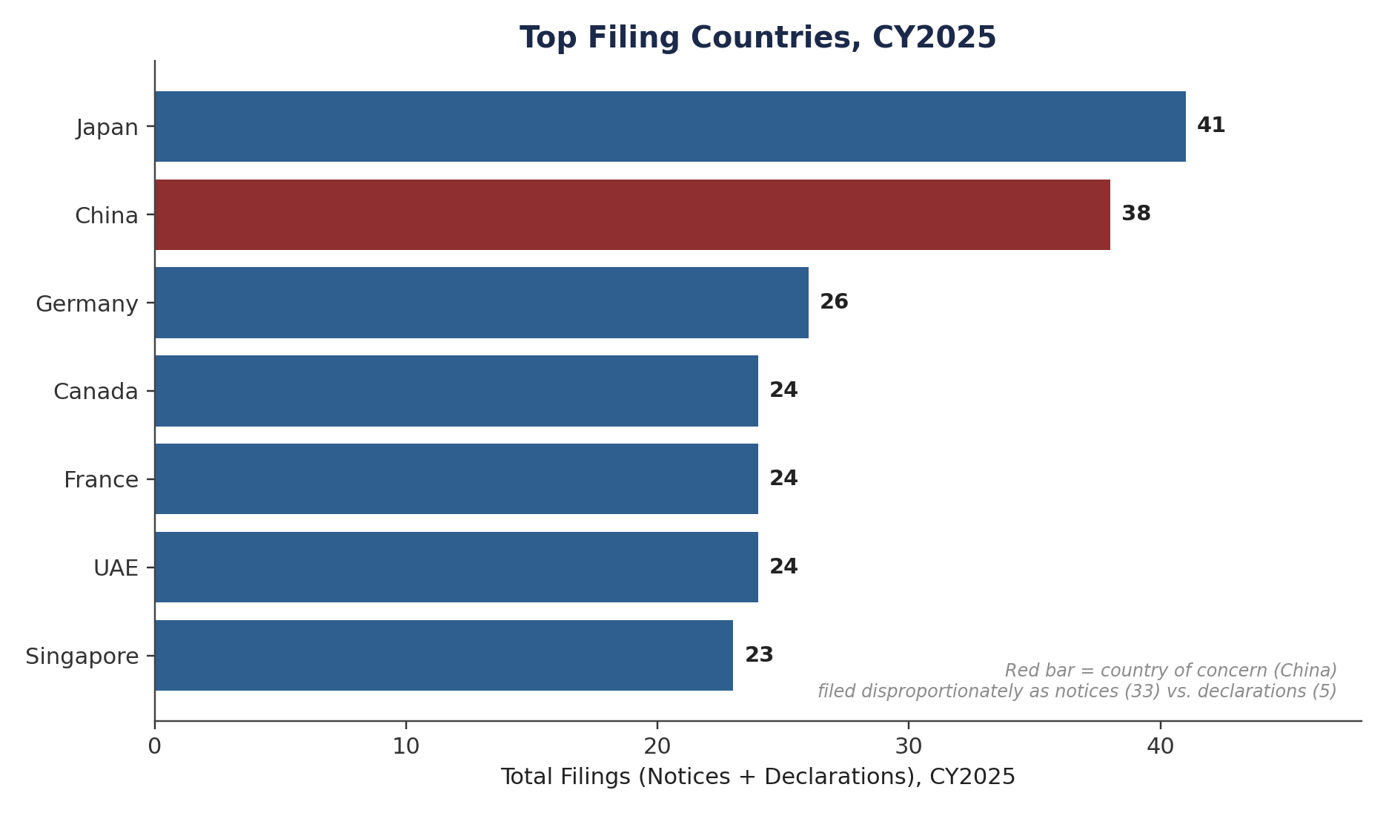
The data suggests that allied and partner-country investors are increasingly making use of the declaration process, consistent with the AFIP’s express goal of streamlining review for allied capital, while investment connected to China and other countries of concern is almost always submitted using the notice path.
Additional Developments Bearing on 2026
Beyond the case statistics, the 2025 Annual Report details certain activities by CFIUS, including:
- Known Investor Program (“KIP”). CFIUS launched this program in mid-2025. The KIP is designed to allow frequent filers to submit detailed investor-level information in advance, with the goal of expediting review of subsequent transactions by the same investor. Still in its nascent stages, little is made available in terms of the potential success and utility of this program.
- Pre-Filing Consultations. A formal pre-filing consultation portal was added to the CFIUS website in July 2026, allowing parties to engage the Committee before a formal filing. For the first 50 years of CFIUS, these consultations ebbed and flowed according to who was running CFIUS, with a post-COVID drawback in these as cases surged. The revival and formalization could prove useful if the portal does not become a wall behind which nothing happens.
- The CFIUS Risk Matrix. Published July 29, 2026, the Risk Matrix does not provide seasoned practitioners with new information, but may prove useful for those unfamiliar with how CFIUS assesses transactions. It identifies eight categories of elevated national-security risk (critical infrastructure, cybersecurity, information security, personal data security, product integrity, proximity concerns, supply assurance, and technology transfer) and provides illustrative mitigation measures the Committee has imposed by category. Though some have suggested that this is the most detailed public articulation of CFIUS’s risk framework to date, that may be overstating it somewhat. The information has been disseminated for years by CFIUS representatives at conferences, and in the executive orders governing and directing CFIUS (e.g., Executive Order 14083). What the matrix accomplishes is pulling this information together on the CFIUS web page.
- USDA MOU. A July 7, 2025, memorandum of understanding (“MOU”) between Treasury and the U.S. Department of Agriculture (“USDA”) formalizes USDA’s role in reviewing transactions implicating agricultural land or agricultural-sector equities, responding to continuing congressional calls for a more active USDA role in foreign acquisitions of U.S. farmland. The action also recognizes that Congress may eventually pass a bill adding the USDA to CFIUS.
- Real Estate Transaction Focus. In November 2024, CFIUS expanded the list of military and other government installations that trigger covered real estate transactions. The increasing number of submitted real estate transactions under part 802 suggests that this expanded real estate effort is generating a steadily growing caseload in this area—or at least that parties now see greater risks in not submitting these transactions.
While the 2025 Report includes some potentially useful data, and suggests some trends, filings will likely increasingly be focused on two factors. First, if mandatory filings are required, the violation risk remains disproportionate. Therefore, the number of mandatory filings will remain correlated to overall M&A deal flow unless Congress expands the category of transactions subject to mandatory filings.
Second, for transactions not subject to mandatory filings, transacting parties must undertake their own risk assessment when deciding whether to file a voluntary notice. The traditional risk criteria remain and likely will not change. Parties should assess, among other things:
- Is the U.S. business involved in the transaction one that will result in a CFIUS inquiry (non-notified review) if no filing is made?
- If no filing is made, will the transaction suffer if CFIUS either (a) requests a filing before closing, thus delaying closing; or (b) requests a filing after closing and imposes mitigation that alters the commercial aspects of the transaction?
- As a corollary, will a filing unduly delay closing so the risk can viably be shifted to after closing?
- Is there value to me in the safe harbor (i.e., if the business might be sold again)?
- Are there national security issues that should be vetted before completing the transaction?
- Is the transaction one where a measure of voluntary mitigation will help?
For more information or assistance, please contact Anthony Rapa or Kenneth J. Nunnenkamp.